When a child has cerebral palsy or another condition affecting movement, “getting around” is never simple. A standard baby stroller usually isn’t enough — because the needs are not the same. A child with a disability doesn’t just need to be transported. They need to be properly supported, safely positioned, and comfortably carried through their daily routine, day after day.
What Is a Rehabilitation (Special-Needs) Stroller?
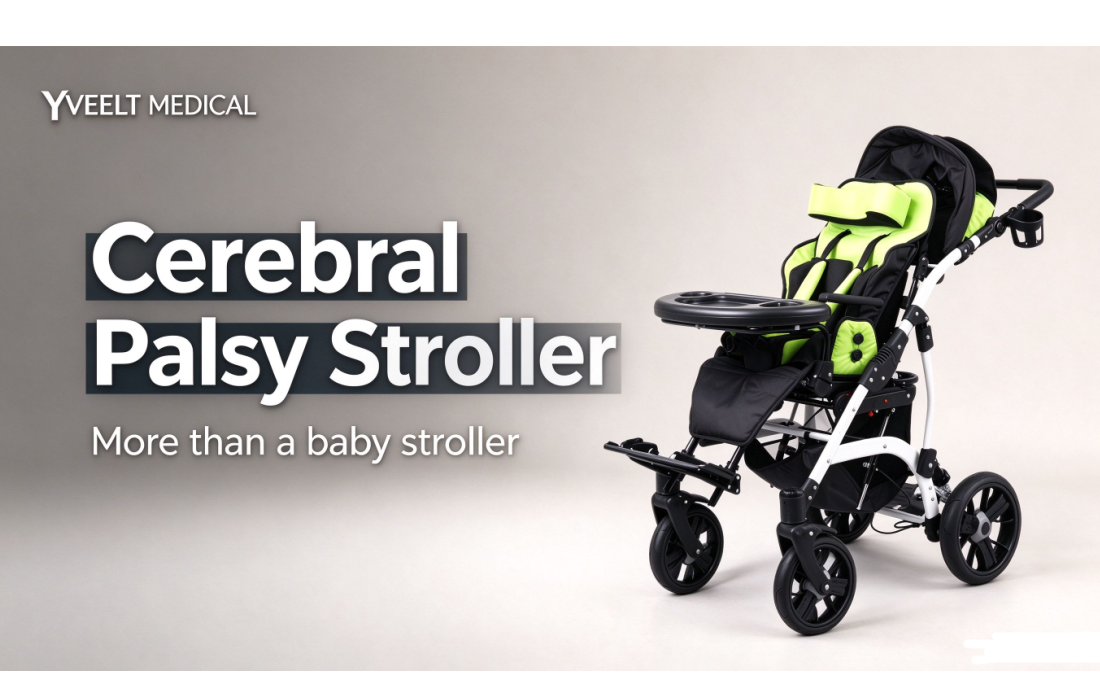
A rehabilitation stroller — also called a special-needs stroller or a rehabilitation walking assistant for children — is a mobility device designed for children with disabilities or motor dysfunction. It is commonly used for children with cerebral palsy (CP), myelomeningocele (spina bifida), muscle disorders, or lower-limb dysfunction resulting from damage to the central nervous system.
Unlike a conventional baby stroller, its main job is not simply carrying a child from point A to point B. It is about:
- Providing long-term postural support
- Supporting positioning and rehabilitation during daily care
- Making everyday outings practical, safe, and comfortable for both child and caregiver
Key Differences from a Standard Baby Stroller
The differences go far beyond appearances. A rehabilitation stroller is engineered around the child’s body, not around convenience. Let’s look at what that means in practice.
1. A Postural Support System Designed for the Child’s Body
The EVR325 from Yveelt is a good example of what “designed for a child with special needs” really means. It comes equipped with dedicated support elements:
- Head stabilizer — helps keep the head in a supported, safe position
- Trunk stabilizer — provides trunk support for a more stable posture
- Side stabilizers — adjustable, for a secure and comfortable fit
- 5-point safety harness with central buckle — holds the child securely in place
These are not cosmetic additions. For a child with limited trunk control, proper positioning helps make sitting safer and more comfortable — which matters for everything from mealtimes to therapy sessions.
2. Made to Fit — and to Grow
Every child is different, and children grow. The EVR325 is adjustable across nearly every dimension that affects fit and comfort, so the stroller adapts to the child’s body shape and size over time, rather than forcing the child to fit a one-size-fits-all frame:
- Seat width: 32–36 cm
- Seat depth: 25–32 cm
- Backrest height: 46–51 cm
- Armrest height: 17–22 cm
The seat and backrest angles are adjustable too, allowing the caregiver to fine-tune the child’s position throughout the day:
- Seat-to-horizontal angle: -30° to 8°
- Backrest-to-seat angle: 103° to 143°
- Leg-to-seat angle: 90° to 180°
3. The Seat Can Face You
One feature many parents appreciate: the seat can be rotated 180° and repositioned to face the caregiver. This makes it easier to monitor the child, communicate with them, and keep them calm — while still allowing the seat to face forward for outings.
4. Built for Everyday Care
- Pneumatic (inflatable) PU wheels with shock-absorbing rear wheels for a smoother ride
- Front wheels that can swivel 360° or lock in a straight-ahead direction
- Rear-wheel brakes for secure stopping
- Folds flat with quick-release wheels — fits easily into a car trunk
- Practical accessories: detachable seat, tray/table, canopy, sleeping bag, small-items basket, cup holder, and lumbar support
Who Is It For?
The EVR325 is designed for children with disabilities and/or movement dysfunctions caused by damage to the central nervous system, including:
- Cerebral palsy (CP)
- Myelomeningocele
- Muscle disorders
- Lower-limb dysfunction
Key Specifications
表格
| Parameter | EVR325 |
|---|---|
| Permitted user weight | up to 30 kg |
| Maximum user height | 130 cm |
| Stroller weight | 19.5 kg |
| Dimensions (L × W × H) | 115 × 61 × 105 cm |
| Folded with wheels | 105 × 61 × 60 cm |
| Front / rear wheel diameter | 23 cm / 30 cm |
| Materials | Aluminum, steel, plastic, rubber |
Important: The EVR325 is designed for use on paved, even surfaces (indoor and outdoor), and the maximum safe slope is 5%. It is not intended for stairs, escalators, running, or skating. Always use the 5-point harness, never leave a child unattended, and adjust all settings with the child out of the stroller.
Safety First — Every Time
- Always fasten the seat belts before use; the harness does not replace proper caregiver supervision
- Never leave a child unattended in the stroller
- Always engage the brakes and lock the driving direction when the stroller is stopped
- Check wheels, brakes, and the driving-direction lock before each use
- Do not add extra loads to the handles or exceed the 30 kg weight limit
- Do not use the stroller as a vehicle seat for transporting a child in a car, bus, or other motor vehicle
A Stroller That Gives More Than a Ride
For a child with cerebral palsy, the right equipment can change the everyday. A rehabilitation stroller doesn’t just move a child from place to place — it supports their posture, protects their body, and gives parents the confidence to get out into the world together.
Choosing the right mobility aid matters.
If you’d like to know whether the EVR325 fits your child’s needs, our team is happy to help — and we can advise on adjustments with your doctor or physiotherapist.
Yveelt Medical · Jiangsu Yveelt Medical Equipment Co., Ltd. · www.yveeltmedical.com