Most electric mobility scooters are heavy steel or aluminum machines. Here’s what changed when I switched to a carbon fiber electric mobility scooter — weighing just 13 kg — and why the material makes all the difference.
The Scooter That Sat in the Corner
I’ll start with an honest confession.
For almost two years, my old mobility scooter lived in the corner of my living room. Not because it didn’t work — because it was too much trouble to use.
It weighed over 30 kg. Getting it into the trunk of my car meant asking someone for help. Bringing it along to a family dinner meant planning the whole afternoon around it. Going into a café with it? Forget it.
So I stopped going out. Not because I couldn’t — because the equipment I was given to help me move was itself the thing stopping me.
Sound familiar?
We Don’t Talk About Weight
Here’s something the mobility industry rarely says out loud: most people don’t stop using their electric mobility scooter because they can’t walk. They stop because the scooter itself became a burden.
Think about the last time you lifted something heavy. Even if you can lift it — maybe with effort, maybe with help — the mental calculation still happens every time:
- Is it worth it?
- Do I have help today?
- What if it rains?
- What if the parking spot is far?
That little calculation is the killer. It quietly shrinks your world, one “maybe next time” at a time.
What “13 kg” Actually Feels Like
When I first heard about an electric mobility scooter weighing 13 kg, I was skeptical. Isn’t that too light to be safe? Too fragile to be real?
Then I tried one.
13 kg is roughly the weight of a large suitcase. It’s the kind of weight you can pick up, adjust, and move without planning. Not because you’re powerful — because it was designed to be moved.
That single change rewired my whole relationship with going outside. Suddenly:
- The car trunk wasn’t a production anymore — I just popped it in.
- A spontaneous coffee run didn’t need a logistics plan.
- Visiting a friend in a third-floor walkup? I could at least consider it.
Weight isn’t a spec. It’s the difference between “I can go” and “I want to go.”
Why Carbon Fiber Is the Secret, Not Just a Buzzword
When I first saw “carbon fiber” on a mobility scooter spec sheet, I’ll admit — I thought it was marketing fluff. Isn’t that just a fancy way to say “expensive”?
It turns out carbon fiber is the reason this whole thing works at all.
Here’s the plain-English version. Most electric mobility scooters are built from steel or aluminum. Steel is cheap and strong, but heavy — that’s why a typical scooter weighs 30 kg and up. Aluminum is lighter, but you still need more of it to get the same strength, so you’re often back in the 20–25 kg range.
Carbon fiber does something neither can. It’s significantly stronger than steel, weight for weight, and far lighter than aluminum. That’s the same material used in high-end road bikes, race cars, and aerospace parts — where saving every gram matters.
For an electric mobility scooter, that means:
- A frame you can actually lift on your own (13 kg, total).
- No rust, even if you ride in the rain or leave it in a humid garage.
- A stiffer, more stable ride — it doesn’t flex or wobble the way a thin aluminum frame can.
- A premium feel that’s obvious the moment you pick it up.
Most scooters could use carbon fiber. They don’t, because it’s expensive to build with. So when you see a carbon fiber electric mobility scooter, you’re not paying for a buzzword — you’re paying for a category of machine that simply doesn’t exist in steel.
But Light Doesn’t Mean Weak
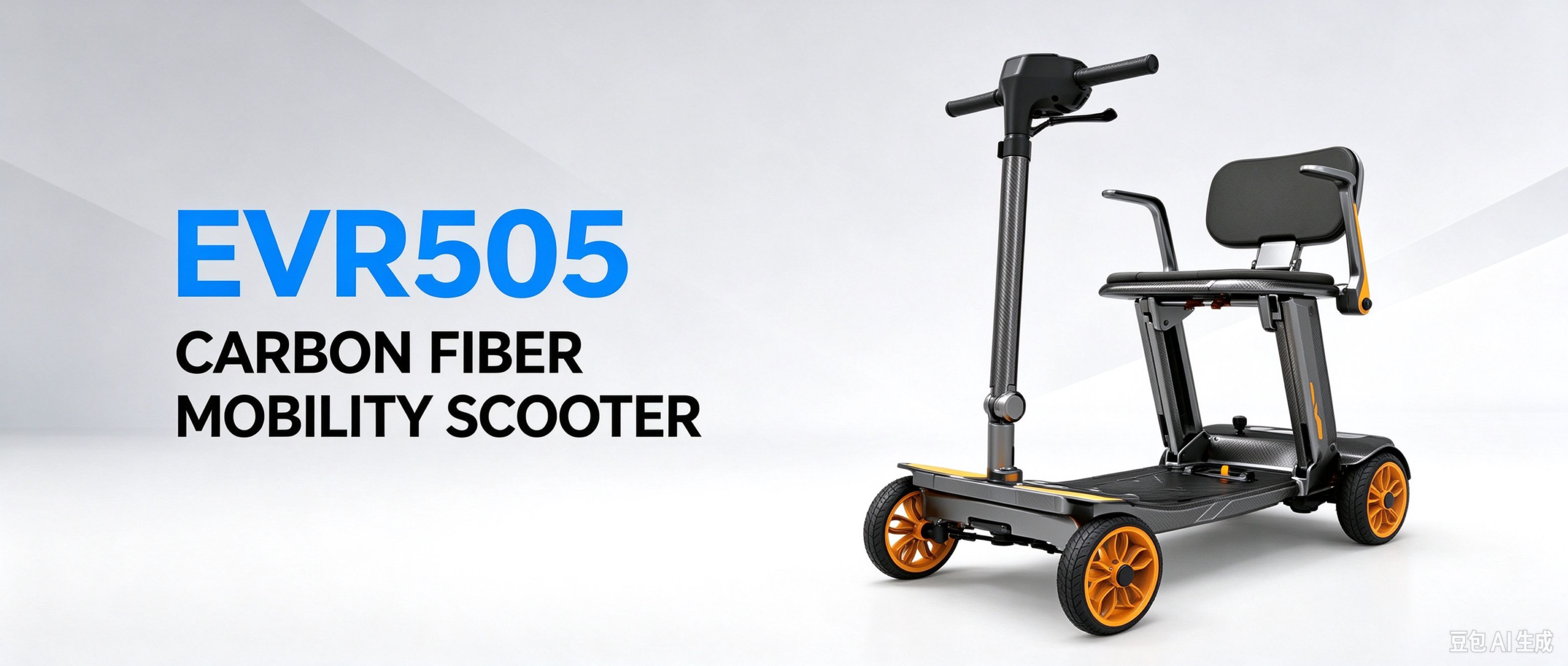
I half-expected a light electric mobility scooter to feel toy-like, to wobble, to make me worry about it breaking. Instead, the one I tried — the EVR505, a full carbon fiber electric mobility scooter — felt solid in a way I didn’t expect.
The carbon fiber frame is the whole reason it can be this light and this strong at the same time. It carries riders up to 120 kg, has a real 10+ km range on a charge, and handles the small slopes and curbs you actually meet in daily life.
I’m not saying it’s a heavy-duty outdoor machine. I’m saying: for 90% of the trips most of us actually make — shops, parks, visits, errands — it’s more than enough.
The Detail That Changed Everything: It Folds
Specs are specs. But the moment that sold me was simply this:
I finished my coffee, pressed the scooter down, and it folded in seconds. I picked it up, walked it to the car, slid it into the trunk, and drove home. No help, no sweating, no “next time I’ll ask my son to come.”
That’s the feeling no product page can really capture. It’s the feeling that your equipment is on your side, not against you.
Who This Is For
I’m not writing this to convince everyone to rush out and buy an electric mobility scooter. Mobility is personal, and what works for me won’t work for everyone.
But if any of these sound like you —
- Your current steel or aluminum scooter spends more time parked than used.
- You find yourself saying “maybe next time” a lot.
- You want to travel, visit family, or just run errands without a production plan.
- You’ve assumed a carbon fiber electric mobility scooter must be fragile, or only for “rich people.”
— then it’s worth taking a serious look at what the right material can actually do for your daily freedom.
You might be surprised what a difference 13 kg makes.
Closing
I don’t think of the EVR505 as a “medical device” anymore. I think of it as the thing that put my weekends back.
Freedom isn’t a top speed number or a range figure. It’s being able to decide you want to leave the house — and then actually leaving.
Most electric mobility scooters ask you to adapt to them. A good carbon fiber electric mobility scooter adapts to you.
If your current equipment isn’t doing that for you, maybe it’s not you that needs adjusting.
Maybe it’s time to feel the difference carbon fiber makes.
Curious what a 13 kg carbon fiber electric mobility scooter actually feels like? Take a look at the EVR505 [here / shop now] — no heavy lifting required.