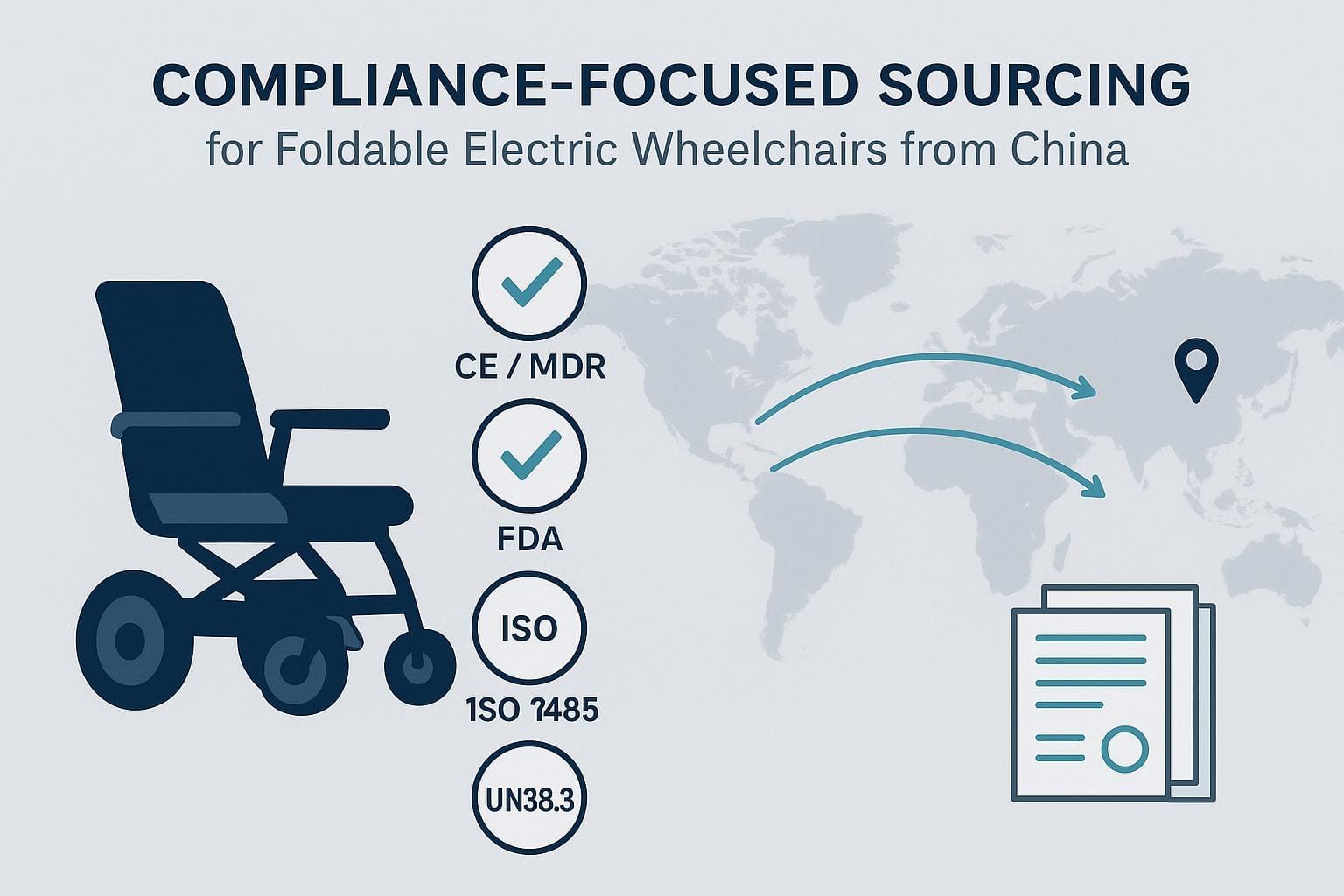
If you’re evaluating suppliers in China for foldable electric wheelchairs, getting compliance right up front saves months of rework and avoids costly import delays. This guide distills the verification steps you need—CE/MDR for the EU, FDA classification and 510(k) for the US, ISO 13485 for quality systems, and UN38.3 for batteries—plus contract red lines for warranty and spare parts. Use it as a repeatable checklist during supplier onboarding, contract negotiation, and pre‑shipment. It’s your baseline for China foldable electric wheelchair sourcing from first inquiry to delivery.
Quick compliance at‑a‑glance
- EU MDR (CE): Confirm device classification, Declaration of Conformity, Notified Body certificate (if Class IIa+), and UDI presence. Validate via NANDO and EUDAMED. See the consolidated MDR on EUR‑Lex and the Commission’s EUDAMED overview.
- FDA: Powered wheelchairs are Class II under 21 CFR 890.3860 with product code ITI—typically requiring 510(k). Check Establishment Registration & Device Listing and 510(k) status using FDA’s databases: Registration & Listing and 510(k).
- ISO 13485: Authenticate the supplier’s certificate using IAF CertSearch, then confirm in the issuing Certification Body registry and the relevant Accreditation Body register.
- UN38.3 & transport: Verify the battery test summary (T1–T8) and prepare IATA/FAA air transport documents; understand IMDG requirements for sea. Use the UNECE UN Manual of Tests and Criteria, IATA’s mobility‑aid guidance, and FAA PackSafe.
Documents to request for China foldable electric wheelchair sourcing
Gather these files early to accelerate due diligence. Each document has a place to verify and a typical red flag.
| Document | What it proves | Where to verify | Typical red flag |
|---|---|---|---|
| EU Declaration of Conformity (MDR) | Manufacturer’s compliance statement with MDR, UDI references | Check UDI format per MDR Annex VI; cross‑reference in EUDAMED public module | DoC references MDD instead of MDR; missing UDI or SRN |
| CE certificate (Class IIa+) | Third‑party conformity assessment | Validate the Notified Body’s scope in NANDO; confirm certificate in EUDAMED | NB number not designated for MDR medical devices; scope mismatch |
| Label samples incl. UDI | Traceability and labeling conformity | Compare against MDR Article 27 and Annex VI; look up UDI‑DI in EUDAMED | UDI unreadable or not found in EUDAMED |
| FDA Establishment Registration & Device Listing | US market access status | Search FDA Registration & Listing; confirm product code ITI (890.3860) | No active registration or listing; wrong product code |
| FDA 510(k) decision (if applicable) | Premarket clearance for Class II powered wheelchair | Search FDA 510(k) database by applicant/device/product code | Supplier claims 510(k)-exempt; no matching 510(k) |
| ISO 13485 certificate | Quality management system for medical devices | IAF CertSearch → CB registry → AB register; confirm site & scope | CB not accredited; certificate covers HQ not factory; expired/suspended |
| UN38.3 test summary for battery pack | Battery safety tests T1–T8 | Verify model alignment; lab accreditation; align with IATA/IMDG | Model or test dates don’t match the pack; missing tests; lab of dubious status |
EU MDR/CE verification workflow
CE under MDR hinges on correct classification, third‑party assessment for higher‑risk classes, and traceability via UDI.
- Determine classification: Powered wheelchairs are typically active therapeutic devices under Annex VIII Rule 9, often Class IIa. Confirm intended purpose and features, and consult your Notified Body for edge cases. Refer to the consolidated MDR text on EUR‑Lex.
- Request MDR DoC, CE certificate (if Class IIa+), and labeling samples: Include UDI‑DI and UDI‑PI evidence.
- Validate Notified Body scope in NANDO: Use the Commission’s portal to confirm the NB is designated for MDR medical devices and relevant assessment modules.
- Search EUDAMED: Look up the manufacturer/authorised representative, device UDI‑DI, and Notified Body certificate in the public modules.
- Check UDI rules: MDR Article 27 and Annex VI govern UDI assignment and labelling. Ensure UDI is on packaging (and device where feasible), and UDI‑DI data is present in EUDAMED.
- Red flags: MDD certificate presented instead of MDR; NB designation not found; UDI missing or not discoverable; actor not registered in EUDAMED.
FDA verification workflow
For US sales, powered wheelchairs fall under Class II and generally require 510(k) clearance.
- Confirm category and product code: Check 21 CFR 890.3860 and the FDA Product Classification page for product code ITI and regulation 890.3860.
- Establishment Registration & Device Listing: Use FDA’s Registration & Listing database to confirm active registration (renewed annually) and device listings aligned to ITI.
- 510(k) clearance: Search the FDA 510(k) database for the supplier/model. Review the summary and decision letter; ensure indications and predicates match a powered wheelchair.
- Signal checks: Review recalls and MAUDE adverse events for supplier risk context via the FDA’s safety pages.
- Red flags: No registration/listing; wrong product code; claims of exemption without a valid basis; no 510(k) record for a powered wheelchair.
ISO 13485 authenticity workflow
Quality system status must be verifiable through accredited channels.
- Start at IAF CertSearch: Confirm certificate existence and issuing Certification Body.
- Confirm at the Certification Body registry: Check certificate scope, sites, issue/expiry dates, and surveillance status. For background, see BSI’s ISO 13485 FAQs.
- Validate the CB’s accreditation in the Accreditation Body register (e.g., CNAS/UKAS/ANAB) to ensure the CB is authorized for ISO 13485.
- Match site and scope against your actual manufacturing location and product category (medical device; wheelchairs).
- Red flags: CB not accredited by an IAF MLA signatory AB; certificate covers a different site; expired or suspended status; overly vague scope language.
Battery and logistics for China foldable electric wheelchair sourcing
Lithium‑ion batteries are central to foldable electric wheelchair logistics. Verification prevents shipment holds.
- UN38.3 test summary: Require the summary covering T1–T8 (altitude, thermal, vibration, shock, external short circuit, impact, overcharge, forced discharge). Confirm the battery model exactly matches the wheelchair’s pack and the test lab’s credibility using the UNECE UN Manual of Tests and Criteria.
- IATA mobility aid rules for air: Follow IATA’s guidance for battery‑powered mobility aids and cross‑check FAA PackSafe for airline handling notes. Installed batteries in mobility aids may be carried with specific protections and airline notifications; removed/spare batteries face Wh limits and carry‑on restrictions.
- Sea freight (IMDG): For UN3481 (batteries contained in/packed with equipment), align packaging/marking with the IMDG Code; SP188 exemptions apply to small cells/batteries that meet conditions.
- Red flags: UN38.3 summary referencing a different pack; installed vs spare battery labelling not clear; missing airline notifications; reliance on outdated IMDG provisions.
Contract red lines: warranty, spares, DOA, traceability, change control
Frame these clauses as buyer standards to ensure service continuity and compliance in China foldable electric wheelchair sourcing.
- Warranty baseline: Define coverage for structural frame, motors/joysticks, controller, and battery. Specify remedies (repair, replacement, credit) and exclusions.
- DOA replacement SLA: Require a clear turnaround (e.g., dispatch of replacement within 7–14 days after DOA verification) and acceptance/return criteria.
- Spare parts availability window: Negotiate guaranteed availability (e.g., 5–7 years) for mission‑critical components and standard consumables, with price escalation caps and advance notice for end‑of‑life.
- Traceability: Mandate serial number and UDI tracking on packing lists and service tickets; require access to documented records (e.g., relevant DHR/DMR excerpts) for severe incidents, aligned with MDR post‑market surveillance expectations.
- Change control and notifications: Suppliers must notify design or component changes that may affect performance or safety, and provide updated documentation.
- Audit and inspection rights: Reserve rights to conduct factory audits and pre‑shipment inspections, with defined acceptance criteria and sampling plans.
Sample clause language (editable)
- Warranty: “Supplier warrants the Device to be free from defects in materials and workmanship for [X] months from delivery. Remedies include repair, replacement, or credit at Buyer’s election. Battery and electronic components carry the same warranty period unless otherwise stated. Supplier will provide failure analysis upon request.”
- DOA SLA: “For DOA units confirmed by Buyer’s inspection, Supplier will dispatch a replacement or issue credit within [7–14] calendar days of notification. Supplier will cover return freight for DOA units.”
- Spares window: “Supplier guarantees availability of spare parts for [5–7] years from the last shipment date. Annual price increases are capped at [Y%], excluding documented raw‑material surcharges.”
- Traceability: “Each unit will ship with serial number and UDI‑DI; service events will reference these identifiers. Supplier will provide relevant technical records for severe safety events in accordance with applicable regulations.”
- Change control: “Supplier will notify Buyer at least [30] days before changes that affect safety, performance, or regulatory documentation, and will supply updated certificates/test reports.”
Pre‑shipment QC and acceptance
Before booking transport, verify documentation, labeling, and functional performance. Think of this as your final gate in China foldable electric wheelchair sourcing.
- Document pack: MDR DoC, CE certificate (if Class IIa+), UDI‑label proof, FDA registration/listing and 510(k) (if applicable), ISO 13485 certificate verification screenshots or registry links, UN38.3 test summary, IATA/IMDG packaging and marking plan.
- Functional checks: Fold mechanism integrity, joystick responsiveness, braking performance, battery health under load, charger compatibility, and accessory fit (armrests, footrests) against the BOM.
- Traceability checks: Serial number and UDI labels match packing lists; battery pack model and serial reference the UN38.3 summary.
- Acceptance criteria: Define pass/fail thresholds (e.g., no cosmetic damage beyond minor scuffs; full function tests passed; labels legible; documentation complete). Reject or quarantine non‑conforming units.
Example: verifying a white‑label foldable electric wheelchair (Disclosure included)
Disclosure: Yveelt Medical is our product. Here’s how a buyer might run verification for a white‑label foldable electric wheelchair and prepare logistics without promotion. Request the MDR DoC, CE certificate, UDI‑label samples, and battery UN38.3 summary. Validate the Notified Body designation in NANDO and confirm device UDI‑DI and certificate entries in EUDAMED. For US sales, check FDA Establishment Registration & Device Listing and search the 510(k) database for powered wheelchair entries under product code ITI. Authenticate ISO 13485 via IAF CertSearch and the Certification Body registry; ensure the manufacturing site and scope match. Compile an air‑shipment plan using IATA’s mobility‑aid guidance and cross‑check FAA PackSafe. For foldable electric wheelchair OEM/ODM process details, see Yveelt’s Services page or browse model families via Electric Wheelchairs.
Common red flags (quick scan)
UN38.3: Summary doesn’t list the correct pack; missing T1–T8 coverage; lab credibility questionable.
CE/MDR: Certificate references the old MDD, NB number not designated for MDR devices, UDI not present or not searchable.
FDA: No active establishment registration/listing, product code not ITI for powered wheelchairs, missing 510(k) where applicable.
ISO 13485: CB is not accredited by an IAF MLA signatory; certificate site/scope don’t match; expired/suspended status.
Optional next steps
If you need a neutral documentation walkthrough or a sample verification run, you can contact the team for a structured review. For OEM/ODM context, see Yveelt Medical’s Electric Wheelchairs and the Services page. Use this guide for China foldable electric wheelchair sourcing and adapt the clauses to your jurisdiction and contracts.